Plan the task. Prepare the body.
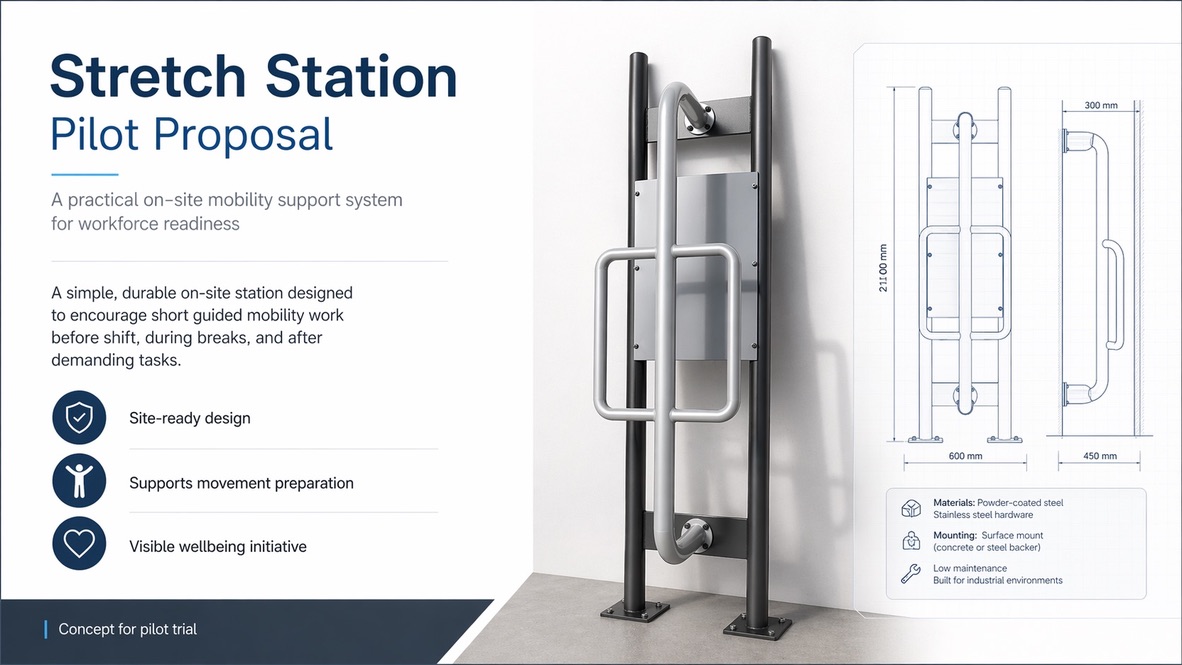
A visible on-site area where workers can complete short movement routines before starting, during breaks or after demanding tasks.
A visible, practical way to prepare the body for work.
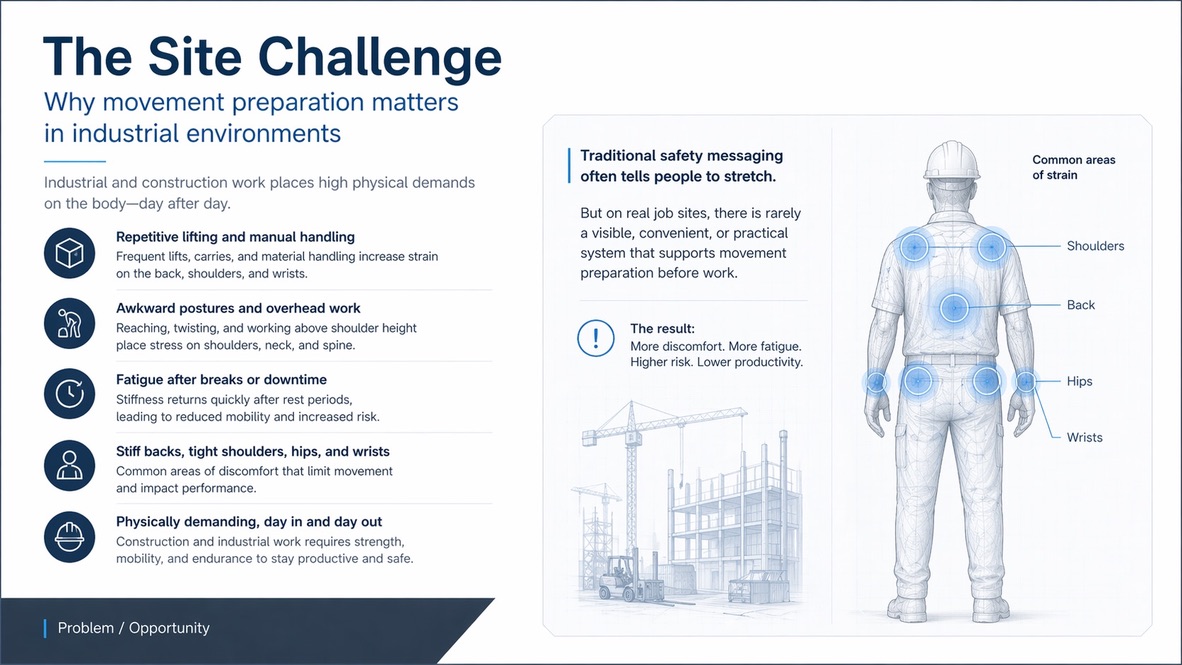
Traditional safety messaging often tells people to stretch. But on real job sites, there is rarely a visible, convenient or practical system that supports movement preparation before work. The Stretch Zone changes that.
RAMS checked. SPA agreed. Crew ready.
The Stretch Zone is a practical site-readiness pilot. It is not a gym, medical facility or replacement for established health-and-safety controls, RAMS, the SPA, site induction or PPE.
Why movement preparation matters.
Industrial and construction work places high physical demands on the body — day after day. Without a practical system to prepare, the result is more discomfort, more fatigue, higher risk and lower productivity.
Repetitive lifting and manual handling
Frequent lifts, carries and material handling increase strain on the back, shoulders and wrists.
Awkward postures and overhead work
Reaching, twisting and working above shoulder height place stress on shoulders, neck and spine.
Fatigue after breaks or downtime
Stiffness returns quickly after rest periods, leading to reduced mobility and increased risk.
Stiff backs, tight shoulders, hips and wrists
Common areas of discomfort that limit movement and impact performance.
Physically demanding, day in and day out
Construction and industrial work requires strength, mobility and endurance to stay productive and safe.
The Stretch Zone.
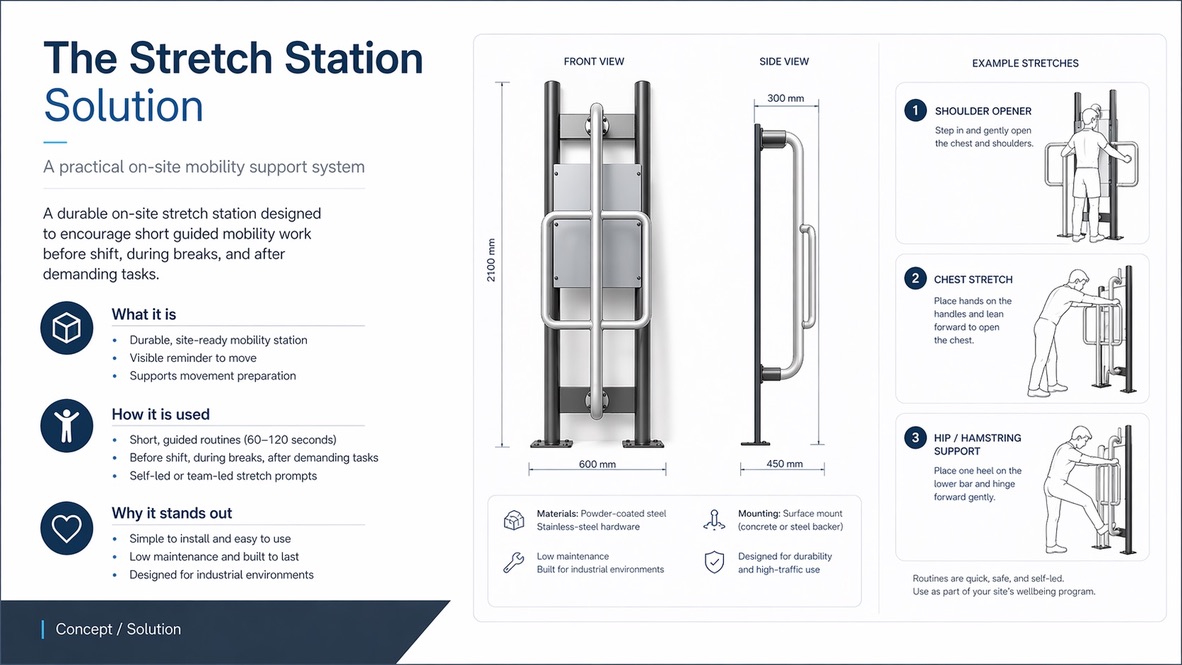
A durable on-site station designed to encourage short guided mobility work before shift, during breaks and after demanding tasks.
What it is
- Durable, site-ready mobility station
- Visible reminder to move
- Supports movement preparation
How it is used
- Short, guided routines (60–120 seconds)
- Before shift, during breaks, after demanding tasks
- Self-led or team-led stretch prompts
Why it stands out
- Simple to install and easy to use
- Low maintenance and built to last
- Designed for industrial environments
Technical specification
Shoulder Opener
Step in and gently open the chest and shoulders.
Chest Stretch
Place hands on the handles and lean forward to open the chest.
Hip / Hamstring Support
Place one heel on the lower bar and hinge forward gently.
Routines are short and self-led. Use as part of your site's wellbeing programme, alongside RAMS, the SPA and your existing H&S controls, not as a replacement for them.
A practical trial for one site location.
A focused, low-impact pilot to validate value, ease of use and site readiness before broader rollout.
Site selection and approval
Confirm suitable location and gain site approval.
Unit installation
Install stretch station and complete safety and quality checks.
Instructional signage and QR demo support
Install signage with QR code linking to short demo and usage guidance.
Feedback and review after trial period
Collect user feedback and review outcomes to inform next steps.
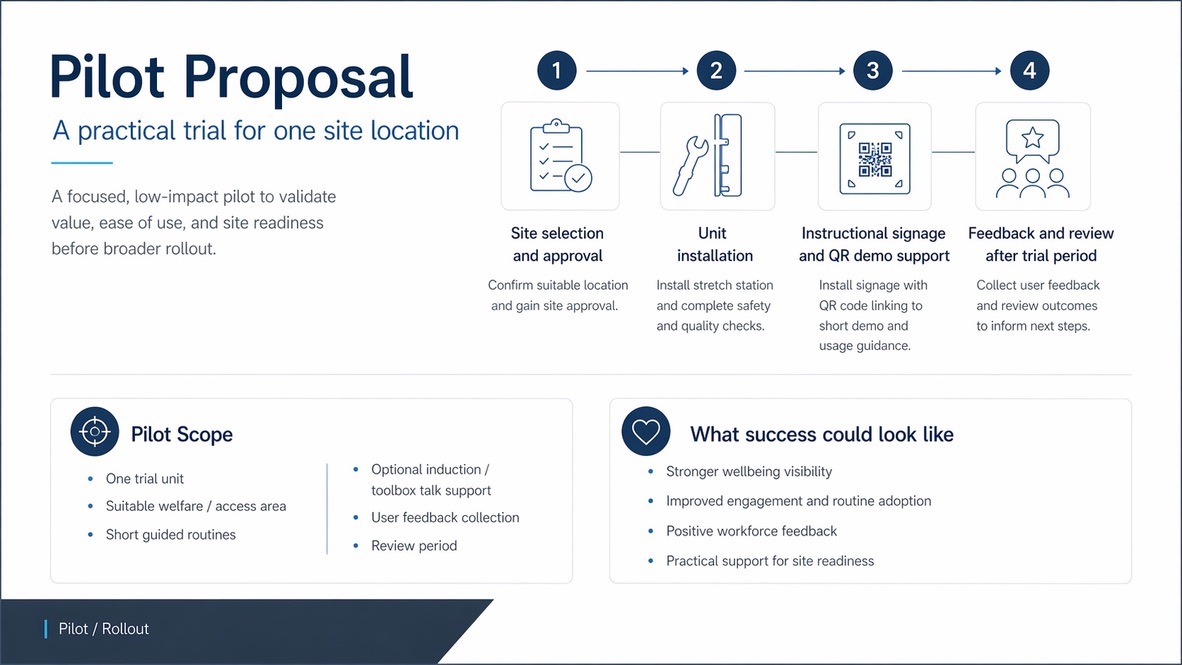
Pilot scope
- One trial unit
- Suitable welfare / access area
- Short guided routines
- Optional induction / toolbox talk support
- User feedback collection
- Review period
What success could look like
- Stronger wellbeing visibility
- Improved engagement and routine adoption
- Positive workforce feedback
- Practical support for site readiness
Trial the Stretch Zone with one crew.
One crew, one location, one review period. Nothing is booked and no health information is recorded: we scope the pilot with you first.
Two minutes before you start.
Three short movements, done at the station: shoulders, chest, hips.
link
Scan for the routines, or open them from the links beside this poster.
On site · ask your supervisorQR links to the crew resources
The poster code points at pages that already exist, so a crew can start the day the station goes up.
- Pre-shift checklist
Five prompts a crew can work through alongside the site briefing.
- Free guides and resources
Printable guides to keep beside the station.
Supervisor setup guidance
- 1
Choose the spot
A dry, level area near the welfare cabin or site entrance, clear of vehicle routes.
- 2
Brief the crew once
Two minutes at the pre-start briefing: what the station is for, and that it is self-led.
- 3
Put the poster up with the station
Poster and QR links go up together, so the routines are one scan away.
- 4
Review at the end of the pilot
Collect feedback from the crew and agree together whether to keep, move or extend it.
A roller, band or ball can sit beside the station. Equipment is subject to availability and is agreed during scoping; the routines work without it.
Opens the workplace enquiry form with the Stretch Zone pilot already noted in your message. Nothing is booked until scope, location and timing are agreed.
Why this concept is worth trialling.
The Stretch Zone is a concept for making movement preparation visible and easy to do before work. It is a proposed service, not a claim about injury rates or safety outcomes.
Workforce readiness
Helps workers prepare their bodies, reduce stiffness and support focus before tasks.
Visible safety culture
Signals a proactive approach to health and safety that people can see and use.
Practical wellbeing support
Encourages positive routine habits that contribute to long-term wellbeing.
Low-complexity implementation
Simple to install, durable, and easy to maintain with minimal disruption on site.
This concept offers a simple and visible way to support movement preparation and reinforce a proactive health and wellbeing culture on site — not a replacement for established H&S controls.
Next steps
- 1
Discuss suitability for pilot
Confirm objectives, target users and success measures.
- 2
Identify installation location
Agree a practical on-site location for access, visibility and use.
- 3
Agree review period and feedback method
Set a review period and collect feedback to assess impact and inform next steps.
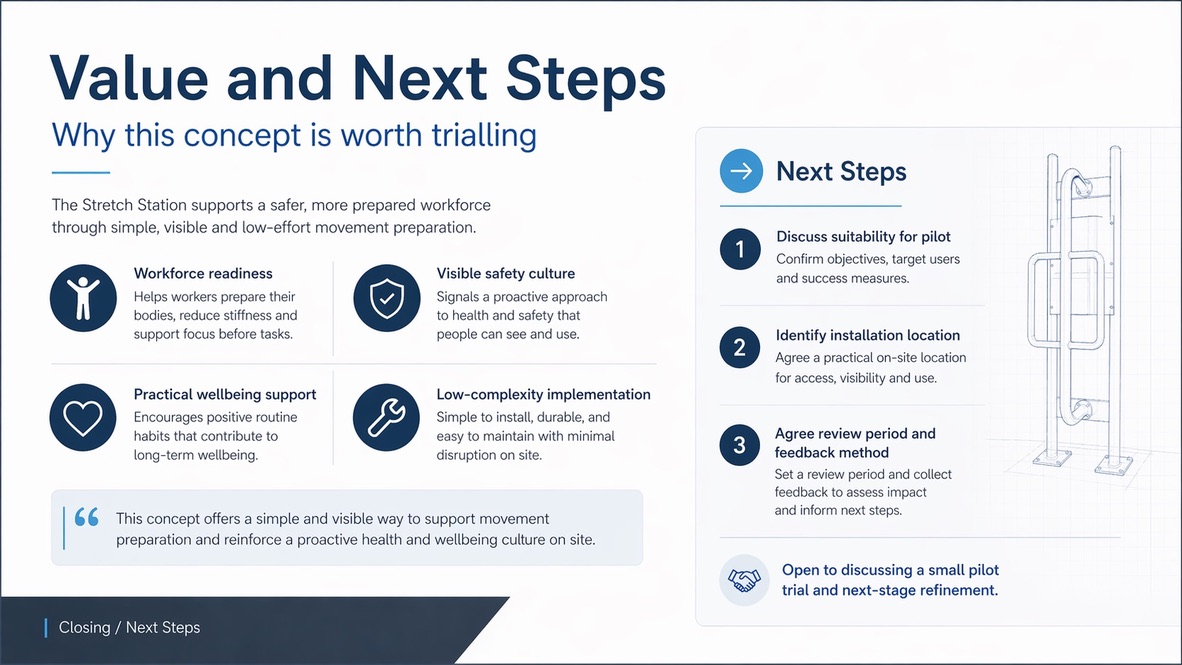
Open to discussing a small pilot trial and next-stage refinement.